Electrician SWMS templates for Australia: 9 editable Word files
Nine safe work method statement (SWMS) templates for Australian electricians and electrical contractors, written in plain words a crew can read on site. Each one is a 4-page Word file you change to fit your job, plus a blank SWMS in the same layout, one print-ready PDF of all nine, and a 3-page guide.
One payment for all three files: A$45 plus 10% GST, which Gumroad adds at checkout for buyers in Australia.
Buy the electrician pack on GumroadSee it on EtsySame pack in both places. Etsy shows its price in your own currency and the shop may run sales there, so the two prices can differ.
Please read. These are templates, not finished SWMS. You must change each one to match your job, your site and the way your crew really works, with the workers who will do the job. This is general information only. It is not legal or safety advice, it is not approved or endorsed by Safe Work Australia or any regulator, and using it does not by itself make any person or business compliant with any law. Have your WHS adviser, or the PCBU, review each SWMS before it is used. Electrical work must be done by licensed people to your state's electrical safety law and wiring rules.
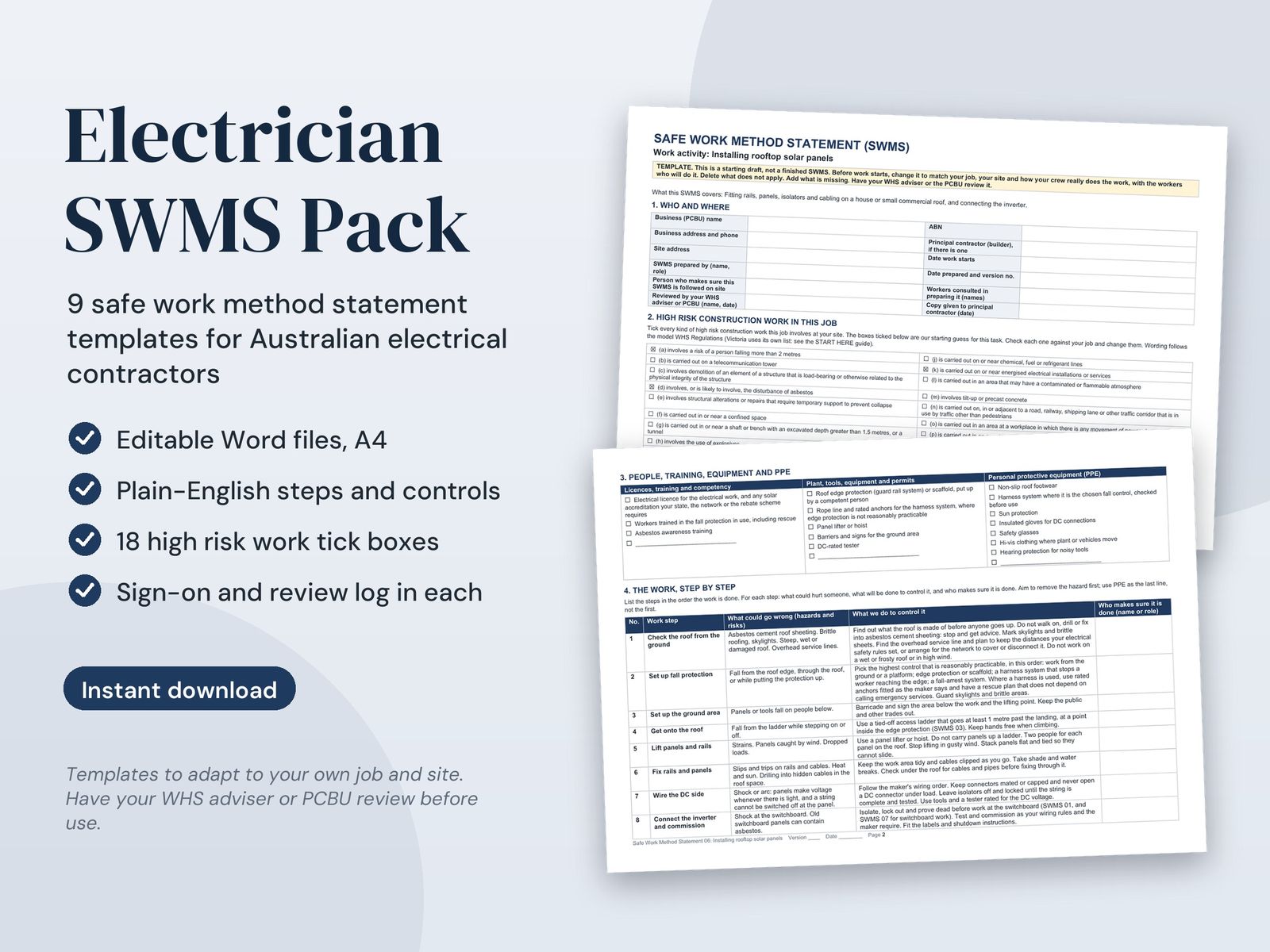
Tap a picture to open it full size. The pictures are renders of the real files.
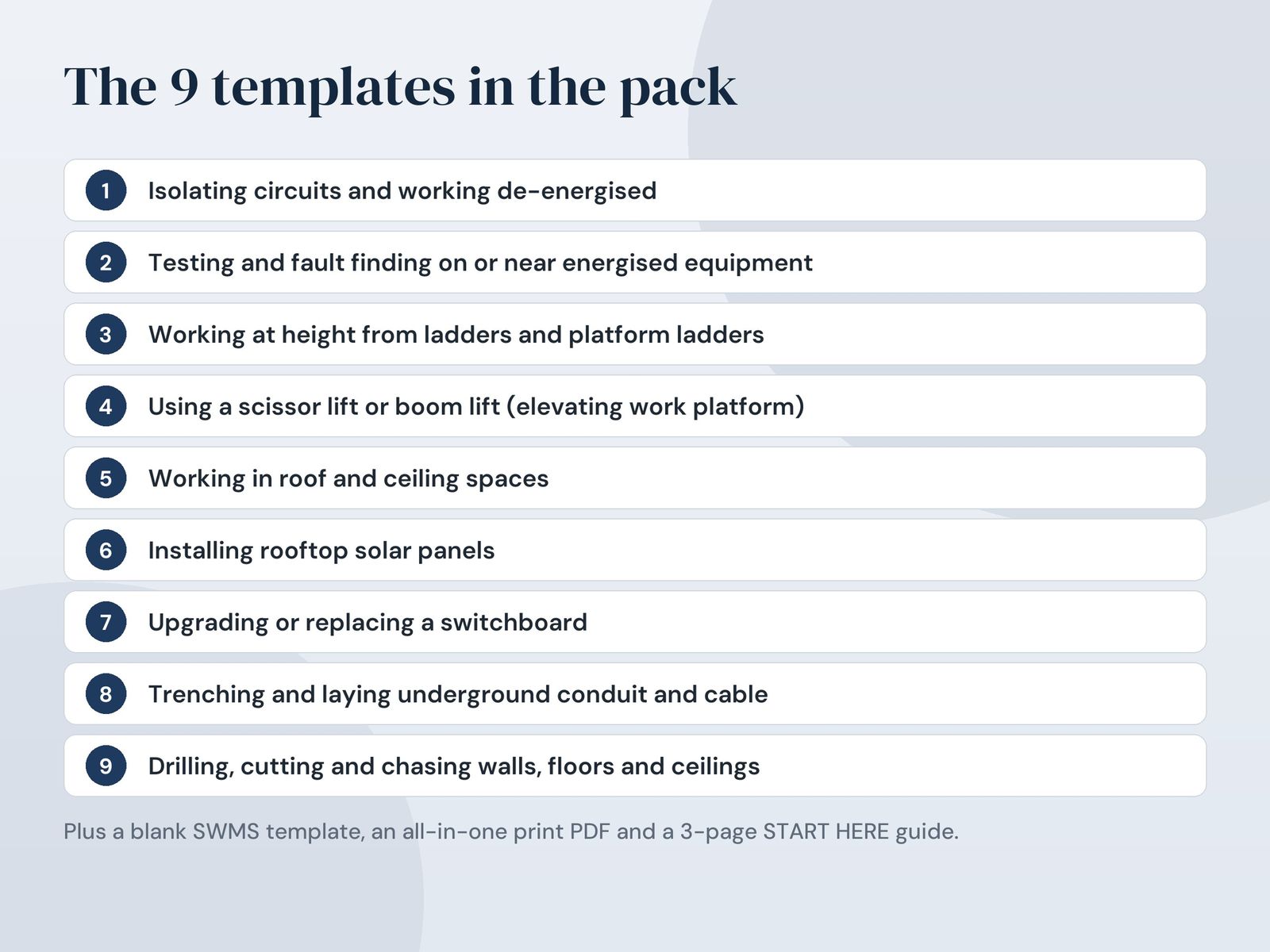
The 9 templates
SWMS 01 (isolation) goes with nearly every job. A job with several high risk tasks can use several templates, or you can copy the steps you need into one document.
01. Isolating circuits and working de-energised
Switching off, locking out and proving dead before any work on circuits, fittings or equipment. Use this with every other electrical SWMS in the pack.
7 work steps. High risk work boxes ticked as a starting guess: (k).
02. Testing and fault finding on or near energised equipment
Testing, measuring and fault finding where the equipment has to be energised for the test. It does not cover live installation or repair work. Work de-energised wherever you can (SWMS 01).
6 work steps. High risk work boxes ticked as a starting guess: (k).
03. Working at height from ladders and platform ladders
Light, short electrical tasks where a person could fall more than 2 metres, such as fitting lights, smoke alarms, cable tray and conduit. For longer or heavier work use a scaffold or an elevating work platform (SWMS 04).
6 work steps. High risk work boxes ticked as a starting guess: (a), (k).
04. Using a scissor lift or boom lift (elevating work platform)
Electrical installation and maintenance from a scissor lift, vertical lift or boom-type elevating work platform (EWP), indoors or outdoors.
7 work steps. High risk work boxes ticked as a starting guess: (a), (k), (o).
05. Working in roof and ceiling spaces
Running cables and fitting lights, fans and equipment from inside a roof or ceiling space in a house or small commercial building.
7 work steps. High risk work boxes ticked as a starting guess: (a), (d), (k).
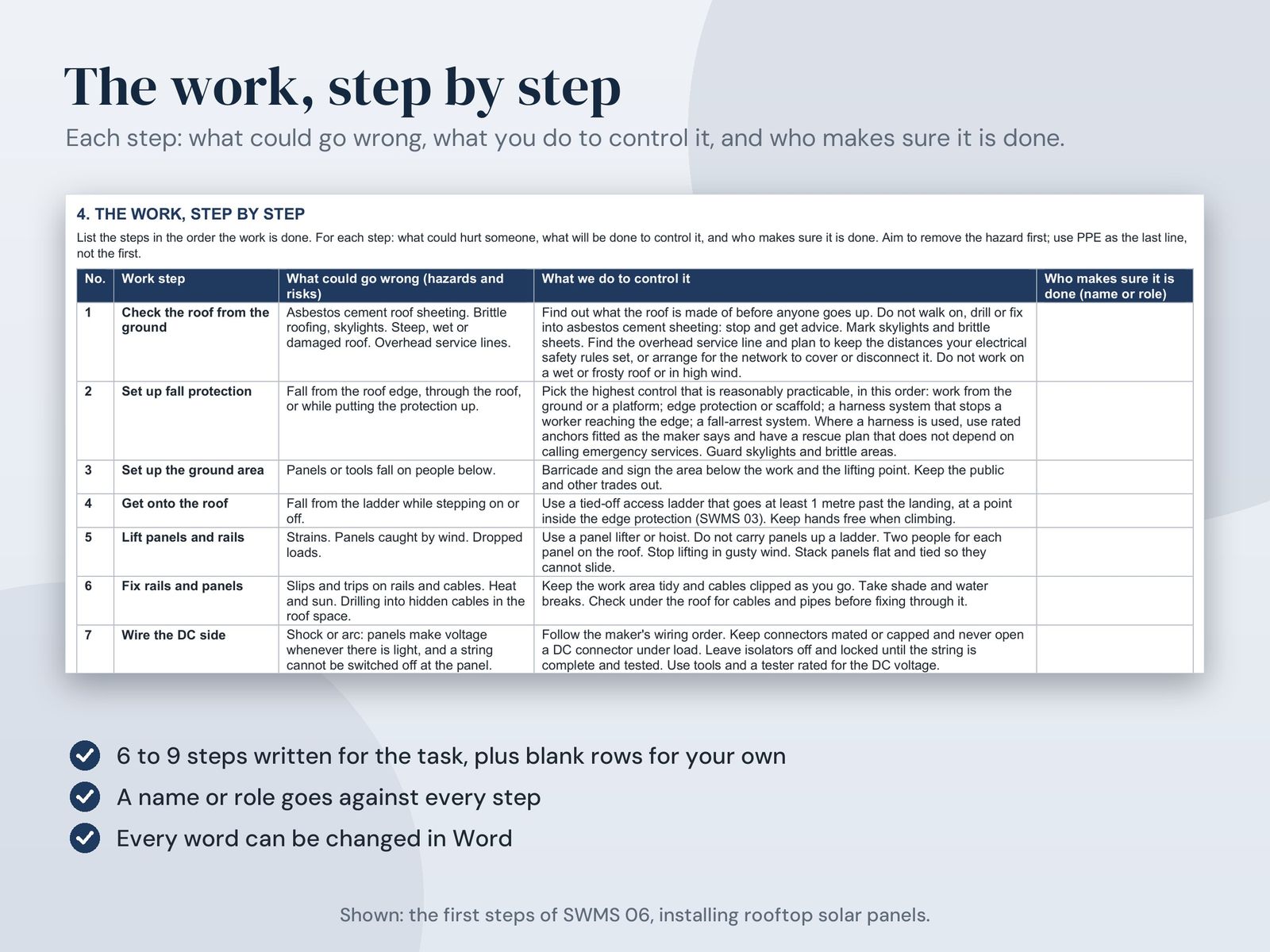
06. Installing rooftop solar panels
Fitting rails, panels, isolators and cabling on a house or small commercial roof, and connecting the inverter.
9 work steps. High risk work boxes ticked as a starting guess: (a), (d), (k).
07. Upgrading or replacing a switchboard
Replacing or upgrading a domestic or small commercial switchboard or meter panel, including fitting safety switches (RCDs).
8 work steps. High risk work boxes ticked as a starting guess: (d), (k).
08. Trenching and laying underground conduit and cable
Digging trenches by hand or with a small excavator or trencher, laying conduit and cable, and backfilling.
7 work steps. High risk work boxes ticked as a starting guess: (g), (i), (k), (o).
09. Drilling, cutting and chasing walls, floors and ceilings
Making holes, chases and penetrations for cables, conduit and fittings in plasterboard, fibre cement, brick, block and concrete.
6 work steps. High risk work boxes ticked as a starting guess: (d), (k).
Plus SWMS 00, a blank SWMS in the same layout for any other task.
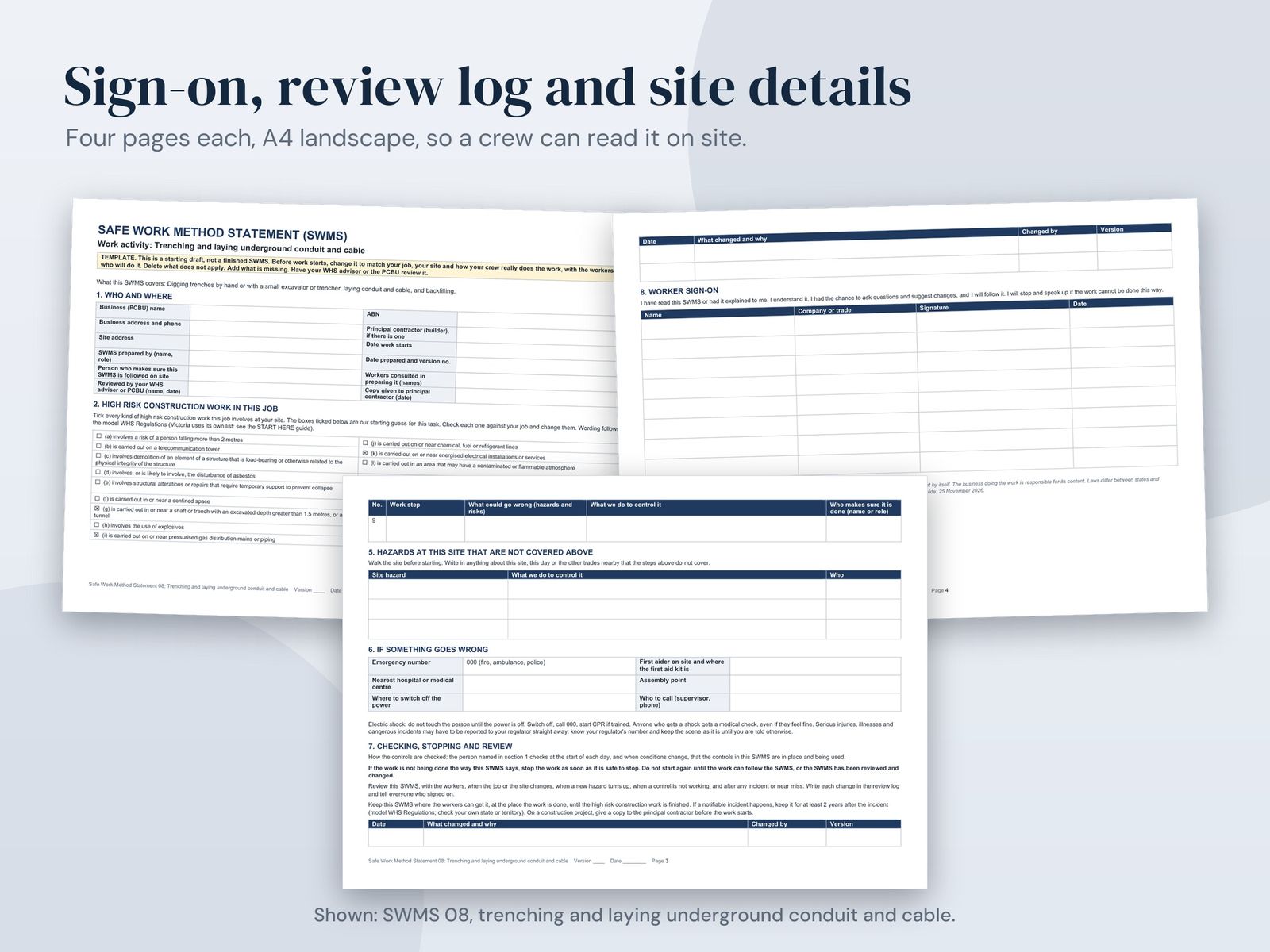
What is in each template
- Who and where: your business (PCBU), ABN, site, principal contractor, who prepared it, who makes sure it is followed, workers consulted
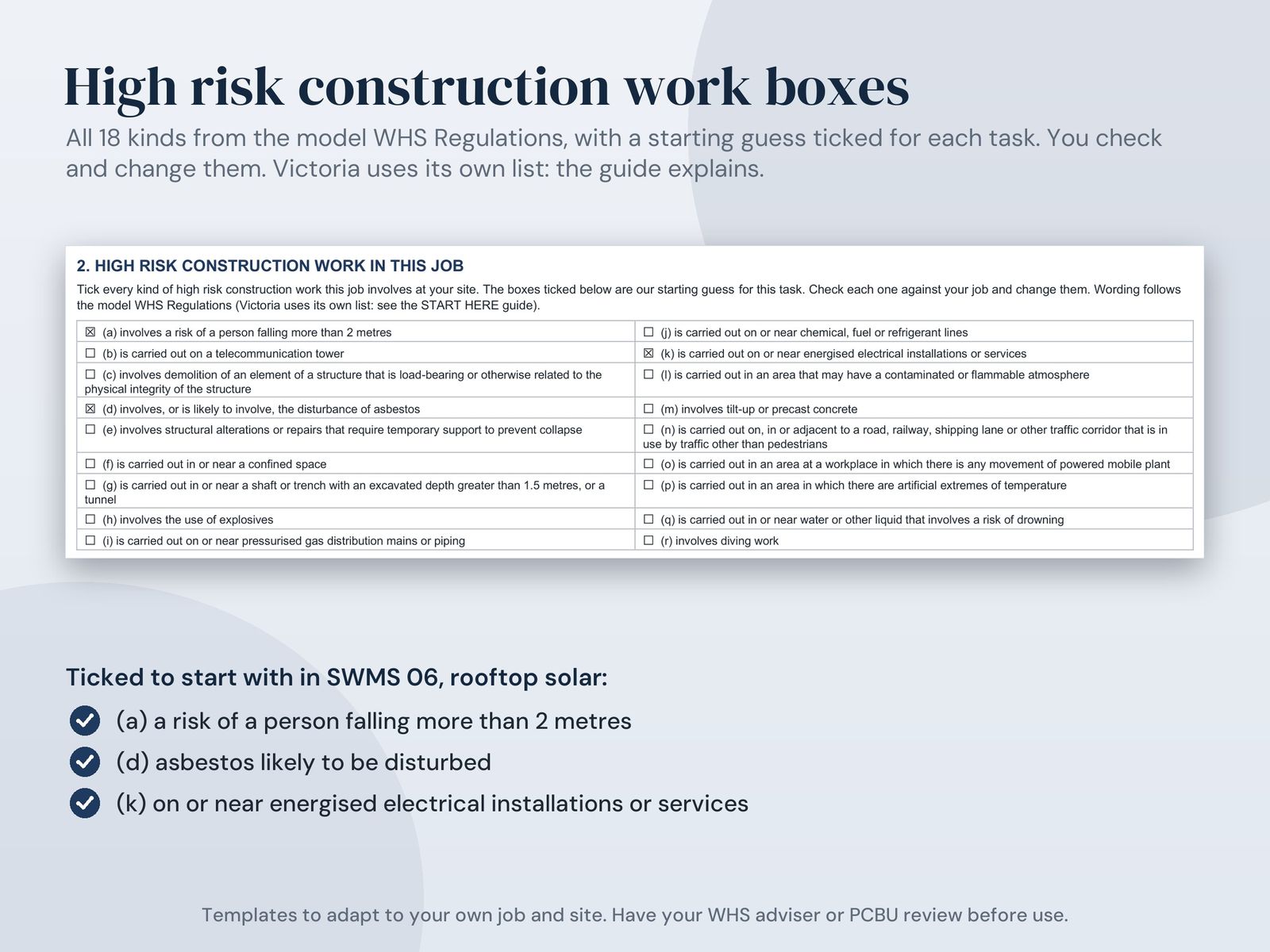
- The 18 kinds of high risk construction work from the model WHS Regulations as tick boxes, with a starting guess ticked for the task, for you to check and change
- Licences and training, plant and equipment, and PPE as tick lists
- The work step by step: 6 to 9 steps, each with what could go wrong, what you do to control it, and a column for who makes sure it is done
- Space for hazards at your site that the steps do not cover
- Emergency details
- How the controls are checked, the stop-work rule, and a review log
- Worker sign-on table
Why it is written this way
- Plain words a crew can read on site
- No risk matrix or scoring columns: a SWMS does not need them, and regulators ask for short, specific documents the workers understand
- Every word can be changed in Word
Licences
Electrical work must be done by people licensed for it, to your state's electrical safety law and wiring rules: this pack does not replace either.
When is a SWMS needed?
Under the model Work Health and Safety (WHS) Regulations, a SWMS has to be prepared before high risk construction work starts. The regulations list 18 kinds of high risk construction work. Construction work that:
- involves a risk of a person falling more than 2 metres
- is carried out on a telecommunication tower
- involves demolition of an element of a structure that is load-bearing or otherwise related to the physical integrity of the structure
- involves, or is likely to involve, the disturbance of asbestos
- involves structural alterations or repairs that require temporary support to prevent collapse
- is carried out in or near a confined space
- is carried out in or near a shaft or trench with an excavated depth greater than 1.5 metres, or a tunnel
- involves the use of explosives
- is carried out on or near pressurised gas distribution mains or piping
- is carried out on or near chemical, fuel or refrigerant lines
- is carried out on or near energised electrical installations or services
- is carried out in an area that may have a contaminated or flammable atmosphere
- involves tilt-up or precast concrete
- is carried out on, in or adjacent to a road, railway, shipping lane or other traffic corridor that is in use by traffic other than pedestrians
- is carried out in an area at a workplace in which there is any movement of powered mobile plant
- is carried out in an area in which there are artificial extremes of temperature
- is carried out in or near water or other liquid that involves a risk of drowning
- involves diving work
These are the 18 tick boxes in section 2 of every template. If none of them applies to a job, the law does not require a SWMS for it, though many builders and clients ask for one anyway. In the model rules, in short:
- The business whose workers do the work (the PCBU; a sole trader is one) must make sure the SWMS is prepared, and workers are to be consulted.
- At a minimum the SWMS must identify the work that is high risk construction work, state the hazards and the risks, describe the measures to control the risks, and describe how those measures will be put in place, monitored and reviewed. It must be easy for the workers using it to understand.
- The work has to be done in line with the SWMS. If it is not, it must stop immediately or as soon as it is safe to do so.
- The SWMS is reviewed and, where needed, revised when the controls change, and a copy is kept until the work is finished.
A SWMS does not need risk scores or a risk matrix. Regulators ask for short, specific documents the crew understands, which is why these templates have no scoring columns.
State and territory notes
One pack covers every state and territory, because the templates are yours to reword. Each state and territory makes its own copy of the regulations: regulation numbers, penalties, dollar thresholds and some details differ, and they change. Always check your own regulator's SWMS page.
New South Wales
Regulator: SafeWork NSW.
Uses the model WHS laws. The 18 tick boxes in the templates follow the model list.
Victoria
Regulator: WorkSafe Victoria.
Has not adopted the model laws. Victoria uses the Occupational Health and Safety Regulations 2017, speaks of an employer or self-employed person rather than a PCBU, and has its own list of 19 kinds of high risk construction work. Most match the model list, but the wording differs: for example Victoria lists construction work involving demolition, involving a confined space, involving a tunnel, and involving removal or likely disturbance of asbestos. WorkSafe Victoria also says not to put risk scores or references to other documents in a SWMS. What to change if you work in Victoria: check section 2 of each template against WorkSafe Victoria's list and reword it; change PCBU to employer or self-employed person; and where a template points to another document (for example "(SWMS 01)", "your wiring rules" or "the maker's instructions"), write the steps themselves in its place. The START HERE guide repeats this.
Queensland
Regulator: Workplace Health and Safety Queensland.
Uses the model WHS laws. Queensland has its own electrical safety law for energised electrical work and exclusion zones. Other states have their own electrical safety regulators and rules too.
Workplace Health and Safety Queensland (worksafe.qld.gov.au)
South Australia
Regulator: SafeWork SA.
Uses the model WHS laws. SafeWork SA's SWMS page now lists the fall item as more than 2 metres; older South Australian documents used 3 metres.
Western Australia
Regulator: WorkSafe WA.
Uses the model WHS laws, in its own version.
Tasmania
Regulator: WorkSafe Tasmania.
Uses the model WHS laws.
Australian Capital Territory
Regulator: WorkSafe ACT.
Uses the model WHS laws.
State differences that matter for electricians
Queensland has its own electrical safety law for energised electrical work and exclusion zones. Other states have their own electrical safety regulators and rules too.
Asbestos rules, including what work an unlicensed person may do, differ by state. When in doubt, stop and ask a licensed asbestos assessor or removalist.
Comcare regulates Commonwealth workplaces. Safe Work Australia writes the model laws and codes of practice but does not regulate.
What you download
- Electrician-SWMS-Pack_START-HERE.pdf: the 3-page guide. How to adapt a template, the rules in short, state notes and where the content was checked.
- Electrician-SWMS-Pack_Word.zip: the 9 SWMS templates and the blank SWMS as Word (.docx) files, A4 landscape, 4 pages each. Unzip it first: on Windows, right-click the zip and choose Extract All; on a Mac, double-click it. Word cannot save changes to a file that is still inside the zip.
- Electrician-SWMS-Pack_All-9_Print.pdf: the 9 templates as one 36-page PDF, to read or print and fill in by hand. It is not a fillable PDF: type into the Word files.
What was tested
Each Word file was opened and exported to PDF in desktop Microsoft Word for Windows. Not tested: Google Docs, Pages, Word for Mac, phone and tablet apps, and printing on paper. In those, tick boxes and table widths may look different.
How to use a template
- Pick the SWMS that fits the task.
- Fill in your business, the site and the people.
- Check the 18 high risk work boxes for this job.
- Read each step with your crew. Change it, delete what does not apply, add what is missing.
- Add the hazards of this site.
- Have your WHS adviser or PCBU review it.
- Brief every worker and have them sign on. Keep it on site. If the work is not following the SWMS, stop when it is safe to stop.
One payment for all three files: A$45 plus 10% GST, which Gumroad adds at checkout for buyers in Australia.
Buy the electrician pack on GumroadSee it on EtsySame pack in both places; only the help line in the guide differs. Etsy shows its price in your own currency and the shop may run sales there, so the two prices can differ.
Common questions
Is this a finished SWMS I can sign and hand to the builder?
No. It is a starting draft. Nothing is filled in for you: the business, site, people and dates are blank. You change the steps to match your job, your site and how your crew really works, with the workers who will do the job, and have your WHS adviser or PCBU review it. A SWMS that does not match the work protects nobody and will not satisfy an inspector or a builder.
Will it make my business compliant?
Not by itself. It is general information, not legal or safety advice, and no regulator has approved it. It gives you a clear layout and plain-word steps to start from.
Does it work in Victoria?
Yes, with rewording. Victoria has its own regulations and its own list of 19 kinds of high risk construction work. See the Victoria note above and the START HERE guide for what to change.
Can I use it for more than one job?
Yes. It is for use inside one business, for as many jobs and workers as you like. Save a copy for each job and adapt it to that site. Please do not resell or share the template files themselves.
What do I need to open it?
Microsoft Word on a computer for the templates, and any PDF reader for the guide and the print PDF. The files were tested in desktop Word for Windows only.
How do I get the files?
On Gumroad, the download buttons show right after checkout and Gumroad emails you a receipt; its View content button opens the download page again at any time. On Etsy, they are under Purchases and reviews in your account, or in the receipt email if you checked out as a guest. Downloading and unzipping work best on a computer.
Can I get an invoice for my records?
Gumroad's receipt email has a link to make an invoice. Etsy sends its own receipt.
What about refunds?
The files download straight away, so we do not give change-of-mind refunds. If a file will not open, or something is missing or not as described here, email us and we will fix it, send it again or send it in another format. Nothing here limits your rights under consumer law.
Who makes these?
From Cedar Loom Prints, a small online shop run by a staffing manager. Made with digital design tools, including AI-assisted ones. We are not WHS advisers or lawyers. The pictures are renders of the real files. The work steps and controls are our own wording of common industry practice; they do not replace the Australian wiring rules, codes of practice, safety data sheets or makers' instructions.
Where the content was checked
The list of high risk construction work, what a SWMS must contain, stop-work and review were checked on 25 November 2026 against the SWMS pages of SafeWork SA, SafeWork NSW and WorkSafe Victoria. The work steps and controls are our own wording of common industry practice; they do not replace the wiring rules, codes of practice or makers' instructions. Rules change: check with your regulator.
Safe Work Australia's own website could not be opened on the day, so the model wording was taken from the regulators' pages. A read by an Australian WHS adviser has not been done on these templates; that is one reason we ask you to have your own adviser review each SWMS.
Other trades
Plumber SWMS templates · Roofer SWMS templates · Painter SWMS templates · Tiler SWMS templates