Roofer SWMS templates for Australia: 9 editable Word files
Nine safe work method statement (SWMS) templates for Australian roofers, roof tilers, metal roofers and roof restorers, written in plain words a crew can read on site. Each one is a 4-page Word file you change to fit your job, plus a blank SWMS in the same layout, one print-ready PDF of all nine, and a 3-page guide.
One payment for all three files: A$45 plus 10% GST, which Gumroad adds at checkout for buyers in Australia.
Buy the roofer pack on GumroadSee it on EtsySame pack in both places. Etsy shows its price in your own currency and the shop may run sales there, so the two prices can differ.
Please read. These are templates, not finished SWMS. You must change each one to match your job, your site and the way your crew really works, with the workers who will do the job. This is general information only. It is not legal or safety advice, it is not approved or endorsed by Safe Work Australia or any regulator, and using it does not by itself make any person or business compliant with any law. Have your WHS adviser, or the PCBU, review each SWMS before it is used. Roofing work must be done by people who hold whatever licence or registration their state or territory requires for it.
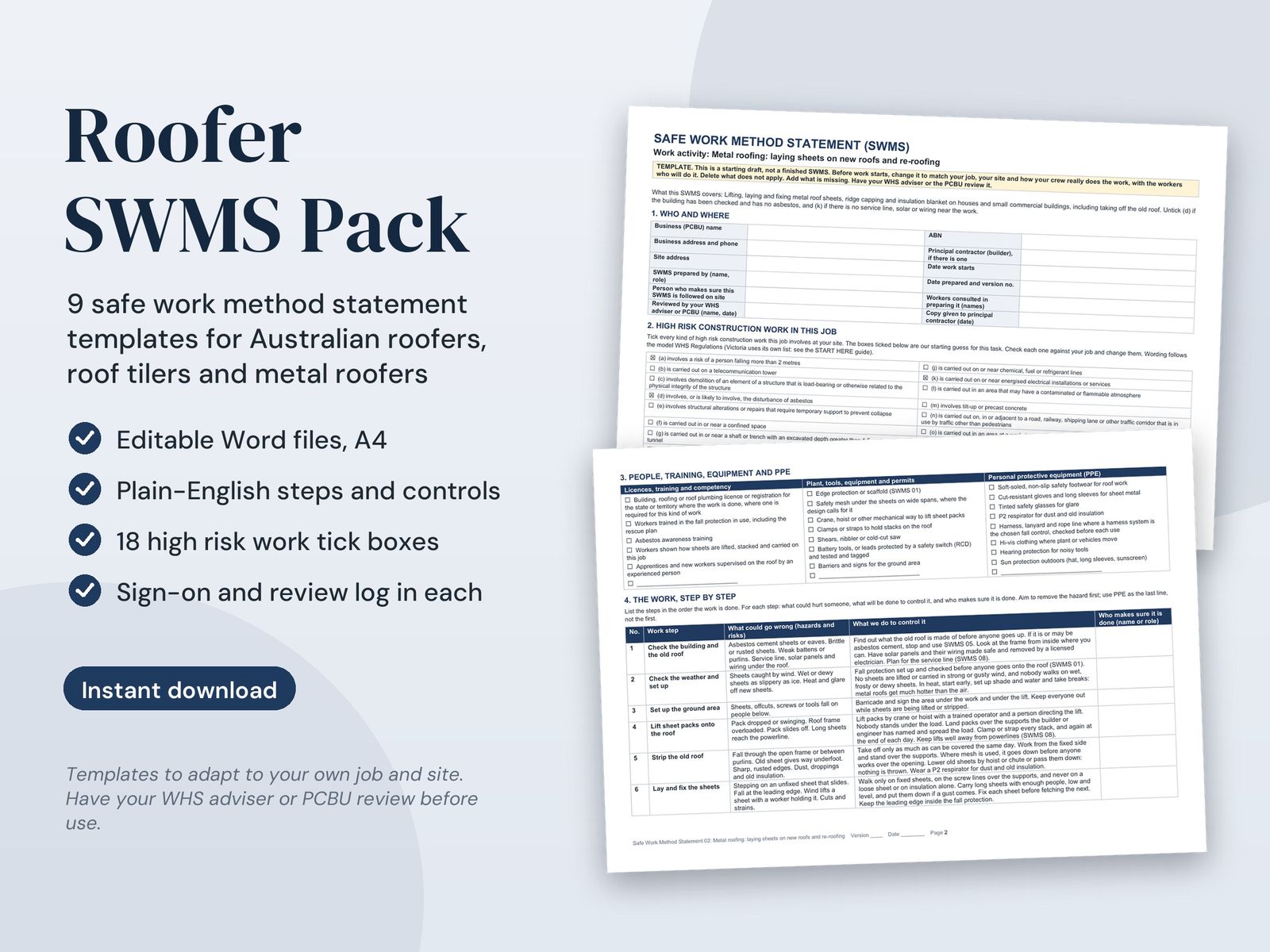
Tap a picture to open it full size. The pictures are renders of the real files.
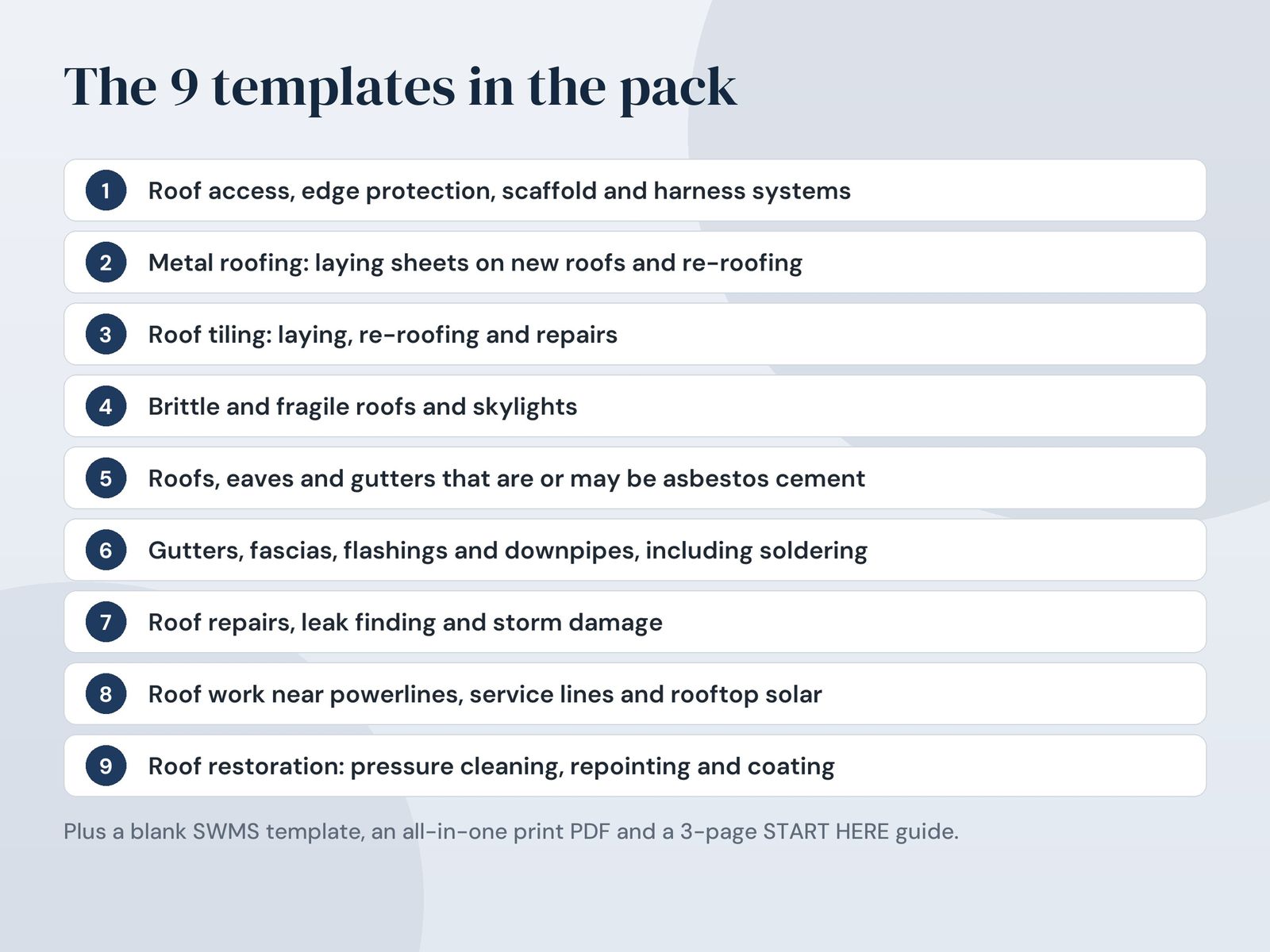
The 9 templates
SWMS 01 (roof access and fall protection) goes with nearly every job. For example, re-roofing an old tin roof can use SWMS 02 with SWMS 01 and, near the service line, SWMS 08.
01. Roof access, edge protection, scaffold and harness systems
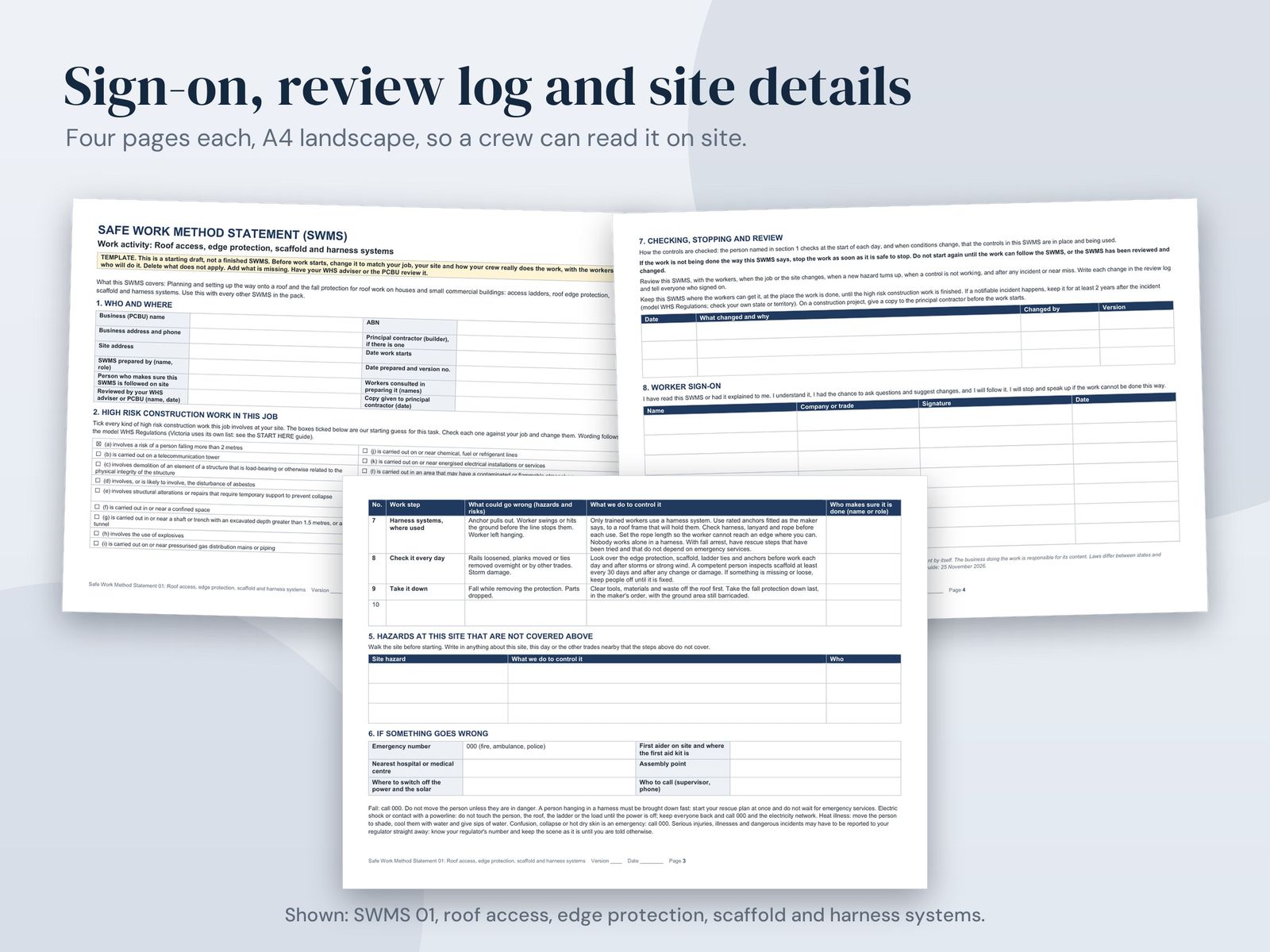
Planning and setting up the way onto a roof and the fall protection for roof work on houses and small commercial buildings: access ladders, roof edge protection, scaffold and harness systems. Use this with every other SWMS in the pack.
9 work steps. High risk work boxes ticked as a starting guess: (a).
02. Metal roofing: laying sheets on new roofs and re-roofing
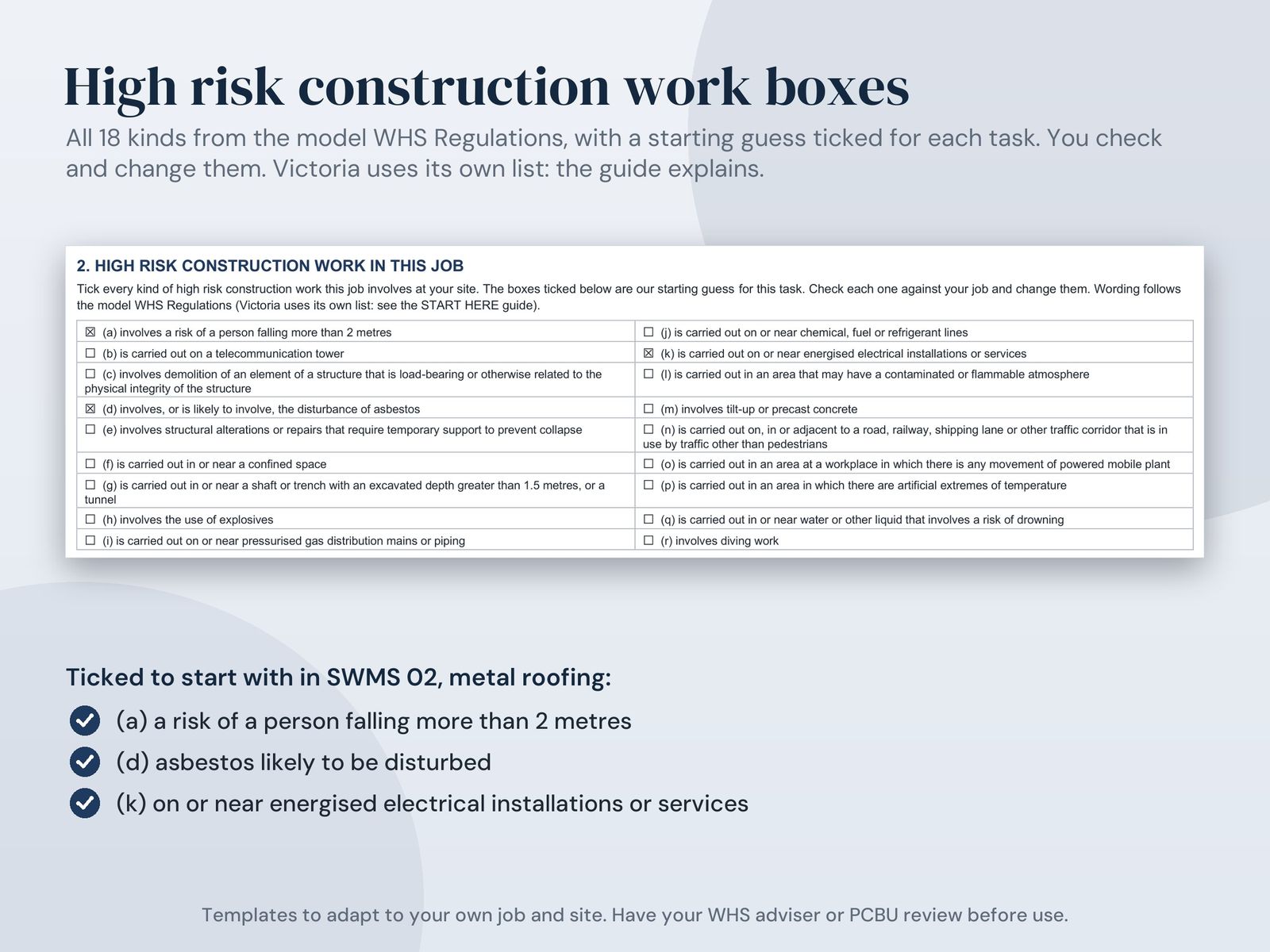
Lifting, laying and fixing metal roof sheets, ridge capping and insulation blanket on houses and small commercial buildings, including taking off the old roof. Untick (d) if the building has been checked and has no asbestos, and (k) if there is no service line, solar or wiring near the work.
9 work steps. High risk work boxes ticked as a starting guess: (a), (d), (k).
03. Roof tiling: laying, re-roofing and repairs
Loading, laying, cutting, bedding and pointing concrete and terracotta roof tiles and slates, replacing battens and sarking, and stripping old tiles.
9 work steps. High risk work boxes ticked as a starting guess: (a).
04. Brittle and fragile roofs and skylights
Work on or next to roofing that will not hold a person: skylights, plastic, fibreglass and polycarbonate sheets, glass, fibre cement and asbestos cement sheets, and badly rusted metal. For asbestos cement use SWMS 05 as well.
8 work steps. High risk work boxes ticked as a starting guess: (a).
05. Roofs, eaves and gutters that are or may be asbestos cement
Finding out whether roof sheets, shingles, ridge capping, eaves, gutters or downpipes contain asbestos, what a roofer must not do to them, and the controls for the small amount of bonded (non-friable) asbestos cement work that state rules let a trained worker do. It is not a method for licensed removal work.
9 work steps. High risk work boxes ticked as a starting guess: (a), (d).
06. Gutters, fascias, flashings and downpipes, including soldering
Taking off and fitting gutters, fascia covers, valleys, flashings and downpipes, and soldering or other hot work on them. Untick (k) if there is no service line or wiring near the work.
8 work steps. High risk work boxes ticked as a starting guess: (a), (k).
07. Roof repairs, leak finding and storm damage
Inspections, leak finding, small repairs and temporary covers on existing roofs, including after storms: replacing tiles and sheets, re-fixing, sealing and tarping.
8 work steps. High risk work boxes ticked as a starting guess: (a).
08. Roof work near powerlines, service lines and rooftop solar
Roof work where people, ladders, long materials or plant could come near overhead powerlines or the service line to the building, and work on roofs that carry solar panels or have wiring under the roofing. Roofers do not do electrical work: this SWMS is about keeping clear.
8 work steps. High risk work boxes ticked as a starting guess: (a), (k).
09. Roof restoration: pressure cleaning, repointing and coating
Pressure cleaning tile and metal roofs, replacing broken tiles, re-bedding and repointing ridge caps, and priming and coating roofs by spray, roller or brush. Never used on asbestos cement roofs.
8 work steps. High risk work boxes ticked as a starting guess: (a).
Plus SWMS 00, a blank SWMS in the same layout for any other task.
What is in each template
- Who and where: your business (PCBU), ABN, site, principal contractor, who prepared it, who makes sure it is followed, workers consulted
- The 18 kinds of high risk construction work from the model WHS Regulations as tick boxes, with a starting guess ticked for the task (a risk of falling more than 2 metres in all nine), for you to check and change
- Licences and training, plant and equipment, and PPE as tick lists
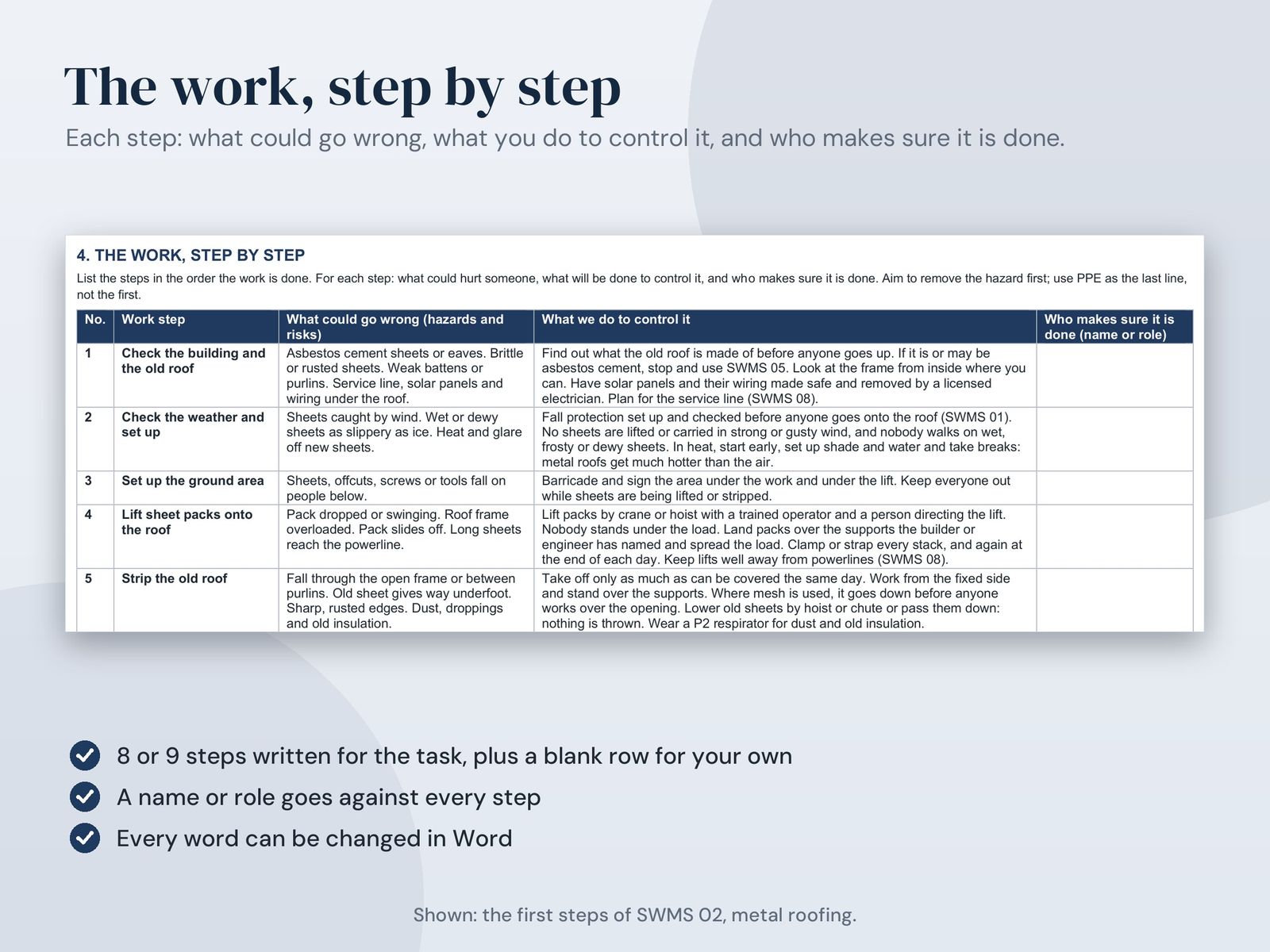
- The work step by step: 8 or 9 steps, each with what could go wrong, what you do to control it, and a column for who makes sure it is done
- Wet weather, wind, heat and sun covered in the steps
- Space for hazards at your site that the steps do not cover
- Emergency details, with fall, powerline contact and heat illness steps
- How the controls are checked, the stop-work rule, and a review log
- Worker sign-on table
Why it is written this way
- Plain words a crew can read on site
- No risk matrix or scoring columns: a SWMS does not need them, and regulators ask for short, specific documents the workers understand
- No licence classes and no powerline distances are named, because they differ in every state: you write in your own
- Every word can be changed in Word
Licences
Roofing, roof tiling and roof plumbing work must be done by people who hold whatever licence or registration their state or territory requires for that work: this pack does not replace it. Licence names, classes and dollar limits differ between states, so the templates name none: write in your own. Electrical work, including work on solar panels, is for licensed electricians only.
When is a SWMS needed?
Under the model Work Health and Safety (WHS) Regulations, a SWMS has to be prepared before high risk construction work starts. The regulations list 18 kinds of high risk construction work. Construction work that:
- involves a risk of a person falling more than 2 metres
- is carried out on a telecommunication tower
- involves demolition of an element of a structure that is load-bearing or otherwise related to the physical integrity of the structure
- involves, or is likely to involve, the disturbance of asbestos
- involves structural alterations or repairs that require temporary support to prevent collapse
- is carried out in or near a confined space
- is carried out in or near a shaft or trench with an excavated depth greater than 1.5 metres, or a tunnel
- involves the use of explosives
- is carried out on or near pressurised gas distribution mains or piping
- is carried out on or near chemical, fuel or refrigerant lines
- is carried out on or near energised electrical installations or services
- is carried out in an area that may have a contaminated or flammable atmosphere
- involves tilt-up or precast concrete
- is carried out on, in or adjacent to a road, railway, shipping lane or other traffic corridor that is in use by traffic other than pedestrians
- is carried out in an area at a workplace in which there is any movement of powered mobile plant
- is carried out in an area in which there are artificial extremes of temperature
- is carried out in or near water or other liquid that involves a risk of drowning
- involves diving work
These are the 18 tick boxes in section 2 of every template. If none of them applies to a job, the law does not require a SWMS for it, though many builders and clients ask for one anyway. In the model rules, in short:
- The business whose workers do the work (the PCBU; a sole trader is one) must make sure the SWMS is prepared, and workers are to be consulted.
- At a minimum the SWMS must identify the work that is high risk construction work, state the hazards and the risks, describe the measures to control the risks, and describe how those measures will be put in place, monitored and reviewed. It must be easy for the workers using it to understand.
- The work has to be done in line with the SWMS. If it is not, it must stop immediately or as soon as it is safe to do so.
- The SWMS is reviewed and, where needed, revised when the controls change, and a copy is kept until the work is finished.
A SWMS does not need risk scores or a risk matrix. Regulators ask for short, specific documents the crew understands, which is why these templates have no scoring columns.
State and territory notes
One pack covers every state and territory, because the templates are yours to reword. Each state and territory makes its own copy of the regulations: regulation numbers, penalties, dollar thresholds and some details differ, and they change. Always check your own regulator's SWMS page.
New South Wales
Regulator: SafeWork NSW.
Uses the model WHS laws. The 18 tick boxes in the templates follow the model list.
Victoria
Regulator: WorkSafe Victoria.
Has not adopted the model laws. Victoria uses the Occupational Health and Safety Regulations 2017, speaks of an employer or self-employed person rather than a PCBU, and has its own list of 19 kinds of high risk construction work. Most match the model list, but the wording differs: for example Victoria lists construction work involving demolition, involving a confined space, involving a tunnel, and involving removal or likely disturbance of asbestos. WorkSafe Victoria also says not to put risk scores or references to other documents in a SWMS. What to change if you work in Victoria: check section 2 of each template against WorkSafe Victoria's list and reword it; change PCBU to employer or self-employed person; and where a template points to another document (for example "(SWMS 01)", "your state's rules" or "as the maker says"), write the steps themselves in its place. The START HERE guide repeats this.
Queensland
Regulator: Workplace Health and Safety Queensland.
Uses the model WHS laws.
Workplace Health and Safety Queensland (worksafe.qld.gov.au)
South Australia
Regulator: SafeWork SA.
Uses the model WHS laws. SafeWork SA's SWMS page now lists the fall item as more than 2 metres; older South Australian documents used 3 metres.
Western Australia
Regulator: WorkSafe WA.
Uses the model WHS laws, in its own version.
Tasmania
Regulator: WorkSafe Tasmania.
Uses the model WHS laws.
Australian Capital Territory
Regulator: WorkSafe ACT.
Uses the model WHS laws.
State differences that matter for roofers
Roofing, roof tiling and roof plumbing are licensed or registered state by state, by different bodies and with different limits. The distances to keep from overhead powerlines are set by each state's electrical safety rules and its electricity networks. Falls, scaffolding, asbestos and silica dust have their own parts of the regulations and codes of practice in each state. Under the model rules, removing more than 10 square metres of non-friable asbestos needs a licensed removalist; some states and territories are stricter. Where cutting or grinding tiles or mortar is high risk crystalline silica work, a silica risk control plan and training are required, and air and health monitoring in some cases. SafeWork NSW says a SWMS may be used instead of the plan for high risk silica work in construction: check what your own regulator says before relying on a template for that. Victoria has its own silica rules. The templates point you to "your state's rules" for these: look them up for where you work.
Asbestos rules, including what work an unlicensed person may do, differ by state. When in doubt, stop and ask a licensed asbestos assessor or removalist.
Comcare regulates Commonwealth workplaces. Safe Work Australia writes the model laws and codes of practice but does not regulate.
What you download
- Roofer-SWMS-Pack_START-HERE.pdf: the 3-page guide. How to adapt a template, the rules in short, state notes and where the content was checked.
- Roofer-SWMS-Pack_Word.zip: the 9 SWMS templates and the blank SWMS as Word (.docx) files, A4 landscape, 4 pages each. Unzip it first: on Windows, right-click the zip and choose Extract All; on a Mac, double-click it. Word cannot save changes to a file that is still inside the zip.
- Roofer-SWMS-Pack_All-9_Print.pdf: the 9 templates as one 36-page PDF, to read or print and fill in by hand. It is not a fillable PDF: type into the Word files.
What was tested
Each Word file was opened and exported to PDF in desktop Microsoft Word for Windows. Not tested: Google Docs, Pages, Word for Mac, phone and tablet apps, and printing on paper. In those, tick boxes and table widths may look different.
How to use a template
- Pick the SWMS that fits the task. SWMS 01 goes with nearly every roof job.
- Fill in your business, the site and the people.
- Check the 18 high risk work boxes for this job.
- Read each step with your crew. Change it, delete what does not apply, add what is missing.
- Add the hazards of this site.
- Have your WHS adviser or PCBU review it.
- Brief every worker and have them sign on. Keep it on site. If the work is not following the SWMS, stop when it is safe to stop.
One payment for all three files: A$45 plus 10% GST, which Gumroad adds at checkout for buyers in Australia.
Buy the roofer pack on GumroadSee it on EtsySame pack in both places; only the help line in the guide differs. Etsy shows its price in your own currency and the shop may run sales there, so the two prices can differ.
Common questions
Is this a finished SWMS I can sign and hand to the builder?
No. It is a starting draft. Nothing is filled in for you: the business, site, people and dates are blank. You change the steps to match your job, your site and how your crew really works, with the workers who will do the job, and have your WHS adviser or PCBU review it. A SWMS that does not match the work protects nobody and will not satisfy an inspector or a builder.
Will it make my business compliant?
Not by itself. It is general information, not legal or safety advice, and no regulator has approved it. It gives you a clear layout and plain-word steps to start from.
Does it work in Victoria?
Yes, with rewording. Victoria has its own regulations and its own list of 19 kinds of high risk construction work. See the Victoria note above and the START HERE guide for what to change.
Can I use it for more than one job?
Yes. It is for use inside one business, for as many jobs and workers as you like. Save a copy for each job and adapt it to that site. Please do not resell or share the template files themselves.
What do I need to open it?
Microsoft Word on a computer for the templates, and any PDF reader for the guide and the print PDF. The files were tested in desktop Word for Windows only.
How do I get the files?
On Gumroad, the download buttons show right after checkout and Gumroad emails you a receipt; its View content button opens the download page again at any time. On Etsy, they are under Purchases and reviews in your account, or in the receipt email if you checked out as a guest. Downloading and unzipping work best on a computer.
Can I get an invoice for my records?
Gumroad's receipt email has a link to make an invoice. Etsy sends its own receipt.
What about refunds?
The files download straight away, so we do not give change-of-mind refunds. If a file will not open, or something is missing or not as described here, email us and we will fix it, send it again or send it in another format. Nothing here limits your rights under consumer law.
Who makes these?
From Cedar Loom Prints, a small online shop run by a staffing manager. Made with digital design tools, including AI-assisted ones. We are not WHS advisers or lawyers. The pictures are renders of the real files. The work steps and controls are our own wording of common industry practice; they do not replace the roofing standards, the building code, codes of practice, safety data sheets or makers' instructions.
Where the content was checked
The list of high risk construction work, what a SWMS must contain, stop-work and review were checked on 25 November 2026 against the SWMS pages of SafeWork SA, SafeWork NSW and WorkSafe Victoria, and the fall protection, ladder, scaffold and asbestos points against SafeWork NSW's working at heights, scaffolding and asbestos pages. The work steps and controls are our own wording of common industry practice; they do not replace the roofing standards, the building code, codes of practice or makers' instructions. Rules change: check with your regulator.
Safe Work Australia's own website could not be opened on the day, so the model wording was taken from the regulators' pages. A read by an Australian WHS adviser has not been done on these templates; that is one reason we ask you to have your own adviser review each SWMS.
Other trades
Electrician SWMS templates · Plumber SWMS templates · Painter SWMS templates · Tiler SWMS templates